Analysis Of Student Learning
The assessment that was chosen for the evaluation of this learning segment was the ‘No Fly List’ mock trial. The trial was put on the last day of the unit after students had been studying civil liberties during wartime for three weeks and had an entire class period to prepare for the trial. The students were assigned specific roles that ultimately dictated which rubric they were to be graded on. There were three different roles: attorney, juror, and witness. The rubric was different because each student had his or her own responsibilities for the trial. By the end of the mock trial all students should have been able to evaluate the constitutionality of the ‘No Fly List’ by presenting and reading evidence in a Mock Trial, and analyze testimony, primary sources, and outside information to make a claim. The rubrics clearly stated these objectives all through the different the graded criteria. The three rubrics used can be found under "Mock Trial Rubric"
The rubrics were differentiated to apply to the three possible roles that a student could have. Although the roles were very different, all of the rubrics aligned with the objectives and learning standards. All three of the rubrics explained that to get a four (highest mark) for the evidence category students had to thoroughly and accurately describes information based on relevant primary and secondary sources; display sophisticated awareness of historical context. This was attainable for all the different roles because although the jurors did not necessarily speak a lot during the actual trial, they were graded on the questions they asked witnesses and the 20 minute deliberation after the trial when they decided on a verdict. The same goes for the category of interpretation and analysis on the rubric. To receive a four in this category students, regardless of their role, had to explain the meaning of evidence from multiple perspectives; compare different interpretations; distinguish clearly between fact and opinion. Finally students needed to be able to show that they had mastered the central focus of the mock trial and the civil liberties during wartime unit in general which was primarily assessed by the evaluation criteria in the rubric. To show mastery student needed to be able to articulate a clear position or decision; evaluate the quality and relevance of evidence; analyzes consequences of decisions.
Because these objectives were so important to be reached it was important to make sure that the activities leading up to the trail were scaffolded enough to produce a deep understanding of the basis of the trial and the developing arguments. Students were given extra scaffolding tools such as graphic organizers, and scaffolded questions to help them to form their arguments. Students were given extra time then originally planned because it was thought that the more front loading of information would lead to a better understanding of the content during the trial.
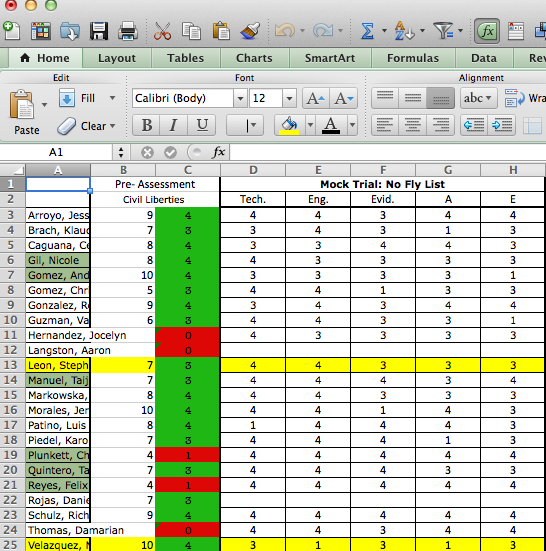
Grades from Pre-test and Mock Trial
Student Performance
Overall students seemed to perform well with “Technical Skills”. This means that for the most part students were able to Display appropriate body language, eye contact, and composure. They were able to maintain appropriate voice projection and diction and actively listen to others. These skills are very important for students to have, however this component of the rubric does not represent higher order thinking skills, which is the most important part of the mock trial. The two categories where students performed the worst on were the “Interpretation and Analysis” and “Evidence”. Many of the students struggled with explaining the meaning of evidence from multiple perspectives and comparing different interpretations of that evidence. I think that students would have benefitted from more modeling on how to construct questions based on evidence. Some students had misconceptions about the fact that people interpret evidence in different ways according to which lens they are looking at that information form. It would have helped their understanding of the evidence if the students had seen an example of differing interpretations.
Students who were members of the jury were much less likely to receive a lower grade because they were not an integral part of the actual trial itself and were not ‘forced’ to speak until after the trial in the jury deliberation. The make up of the trial allowed for certain students to excel in areas where they did not usually excel in, while it allowed for other students to not be pushed as much as they could have been.
Focus Students
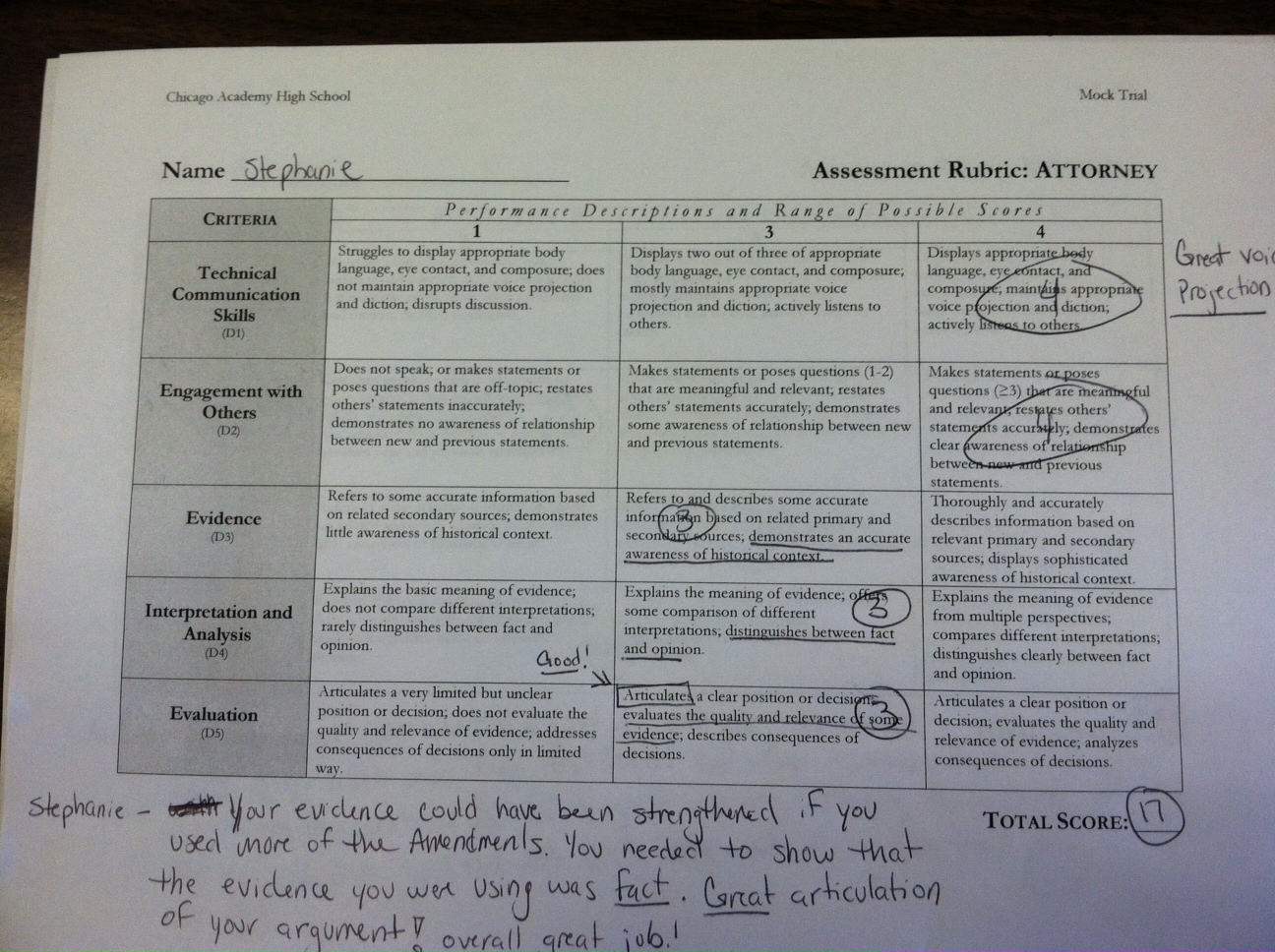
The two students that I chose to focus on were Stephanie and Melissa. Stephanie is a 17 year old who is retaking United States history for the second time. Stephanie is an auditory learner. She comprehends information best when she hears it. Stephanie can usually remember information more accurately when it has been explained to her orally. Stephanie can remember quite accurately details of information that she hears during conversations or lectures. Stephanie has strong language skills including a well-developed vocabulary. These strong language skills contribute to Stephanie ’s strong oral communication skills. These skills definitely transferred well to being an attorney for the prosecution, which was the role Stephanie played in the trial. Although Stephanie is a very bright young woman, she has trouble reading and then comprehending text at the same level as if the information was read or told to her aloud. Stephanie also struggles with written communication and faces challenges when taking written tests or writing research papers and essays. It is very important for Stephanie to read aloud to herself if she has to read through text individually. It is also important for her to take notes often when reading, and then read those aloud to herself as well in order to retain the information
Because Stephanie is so well spoken, giving her the role as an attorney was definitely a way for her to excel in the trial. However, it was the work Stephanie had to do before the trial that was extremely challenging for her. In preparation for the trial all of the attorneys had to read through the witness testimony and the evidence in order to form their case either for or against the No Fly List. This was a lot of reading for any student to get through especially a student like Stephanie. In examining her work samples Stephanie had a lot of trouble comprehending the testimony. Furthermore Stephanie was unable to find the aspects of the witness testimony that would help make her claim. Stephanie left some of the scaffolded question barley answered or did not answer them at all. I know that Stephanie was working hard on the testimony the graphic organizer was simply not the best way for her to understand and use the information that he needed for the trial.
Although Stephanie did not complete all of her pre trial work sheets, it is evident by looking at her rubric that she excelled in the trial. Stephanie benefitted greatly form being able to discuss the testimony before the trial with his team of attorneys. Stephanie received a four in interpretation and analysis as well as in evaluation- the two most challenging parts of the rubric. This proves that Stephanie was well prepared for the trial and that he was able to meet the objectives of the rubric.
Melissa is a 16 year old junior in my U.S. history class. Melissa is relatively strong with most aspects of the United States history class. She has a good work ethic, and is at grade level on all of her reading and writing skills. Although Melissa is a good student, she is rather shy which restricts her participation in class. Melissa does not often take part in class discussions-a very important aspect of the class- and this not only hinders her grade, but also leads to her accepting that she is not a strong speaker. I find it hard to help Melissa with her public speaking skills because the class is centered on independent decisions about ones learning. During class discussions I do not force students to speak because I attempt to foster intrinsic learning and ownership in ones work. When I have spoken to Melissa after she has not participated in class discussions she assures me that she understood the material, she was just not ready to speak. It is for these reasons that I assigned Melissa the role of witness because I hoped that she would step up to the plate and show the class her full potential.
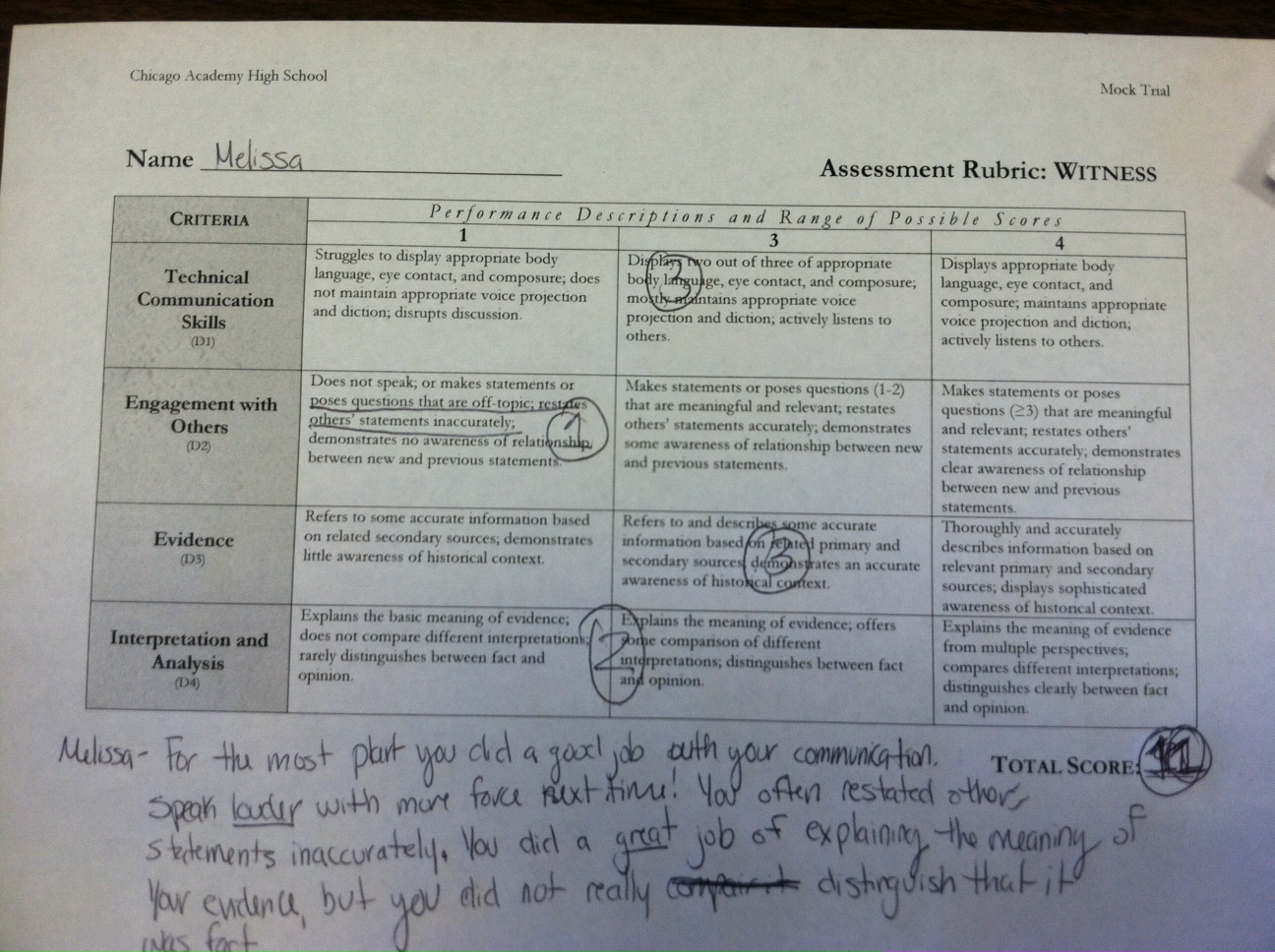
Melissa was a witness for the prosecution in the Trial. Melissa performed poorly in her ability to interpret and analyze the information. In video two and three Melissa is able to explain the evidence that she is being presented with (the fourth amendment) however she is not able to show a deep meaningful explanation of why these amendments were important in this case. On her rubric Melissa received a 1 in technical communication skills because her voice level was not loud enough, she did not respond to a lot of the questions that the attorneys asked her, and she was not fully engaged with the trial when she was not on the stand.
Feedback to Guide Further Learning
Feedback for the mock trial was given via a rubric. The feedback was written straight on the rubric along with the score that the student received for each of the criteria.
Using Assessment to Inform Instruction
Using a mock trial as an assessment has both its advantages and disadvantages. A mock trial is a great way for students to showcase their public speaking abilities, communication skills, and higher order thinking. These are all very important skills for students to have. High school students especially need to be assessed on these skills because they will need to use them in college or in the work place. The rubric was very specific about what expectations each student needed to meet in order to earn a certain number of points. The different categories on the rubric broke up the assignment in a way that allowed for important conversations about the mock trial afterwards. Using the mock trial as an assessment allowed me to see the strengths and weaknesses of my student’s oral communication skills as well as their ability to work in groups. It was very evident when a student was not prepared for their part of the trial and it was easy to express that on the rubric.
Although there are some very positive reasons to use a mock trial in the classroom, there are also many disadvantages that become a reality with these types of assessments. One issue that comes up is when a student does the work, and understand the content, but does not perform well once if is finally their turn to speak. This happens for a host of different reasons, one of them being nerves. If I were to do this mock trial again I would add another component to the rubric so that the students would be graded on the work that was completed before the trail. There were multiple students who I know understood the material, but had not mastered communicating that information in a way compatible with a mock trial format.
There was also an issue with the amount of work each student had to do depending on the role they were assigned. The 6 students that were assigned to be the attorneys had the most work to do prior to the trial. The attorneys needed to read all of the witness testimony, create questions based evidence and then present those questions to a class in a meaningful way. Although the jurors had a graded deliberation after the trail where most of their grade came from, they still were not on stage as much as the attorneys and did not have to prepare questions. If I were to put this trial on again I would create something more substantial for the jurors to do before the trial and make sure that they had to produce their work during the trial at some point.
Next step instructions would be different for Stephanie and Melissa. Stephanie needs to have more practice in reading and expressing herself through the written word. It would be helpful to assign a project where students needed to write a persuasive essay that would allow her to work on writing her thoughts down. Stephanie would benefit from a lot of modeling on how to outline an essay to help write down what she is thinking.
Melissa definitely needs to continue working on her public speaking skills and her articulation of thought orally. One of the reasons that Melissa does not try harder in class when it comes to discussions is because she does not see the benefit of public speaking skills. She has explained multiple times that those skills are not as important as the other skills that are part of this United States history class, such as reading, writing, and content skills. I believe that Melissa would definitely benefit from learning about the importance of articulating your words in college and in life after high school. Melissa would also profit from being put in a leadership position. Melissa definitely has the skills to excel in that aspect of her life, see just does not see herself in that role.