Content Focus
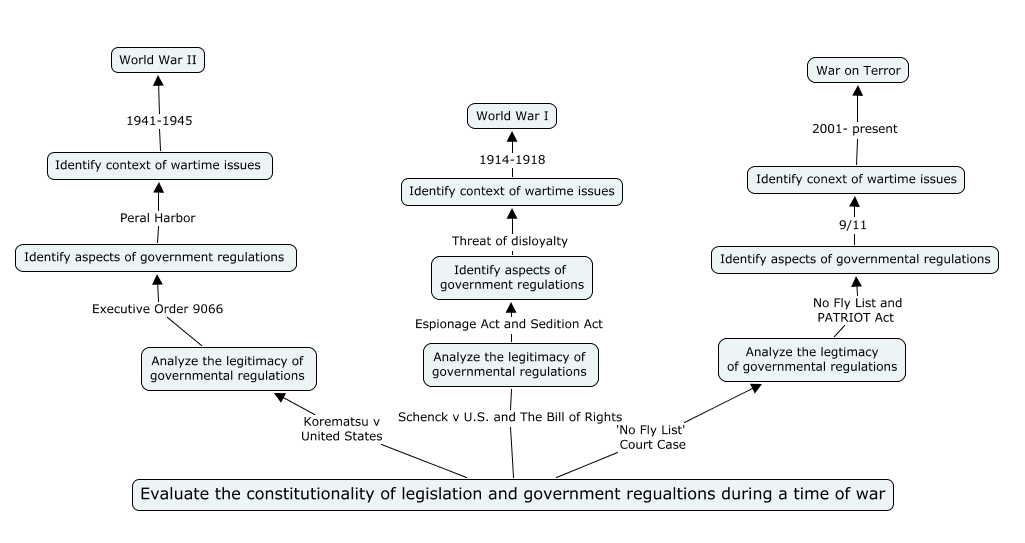
The content that I am teaching during this learning segment is civil liberties during wartimes. Throughout this unit students examined the restriction of civil liberties during three different times of war: World War I, World War II, and the War on Terror and 9/11. In this specific learning segment students are looking at the Bill of Rights and restrictions of civil liberties post 9/11, and encompasses three lessons: lesson one, lesson two, and lesson three . Students are being asked use the Bill of Rights to decide if restriction and regulations such as the Patriot Act, and the No Fly List are violations of peoples civil liberties.
Throughout this learning segment students are being asked to look at the bill of rights and compare them with restrictions that have been historically put on civil liberties due to war. Students are asked to form their own opinions on weather or not these restrictions are unconstitutional. In the final activity of this unit students are conducting a mock trial to determine if the No Fly is a violation of peoples civil liberties and if so, are those violations necessary to protect the lives of the American people. This activity allows students to not only see how a trial works, but to play important roles of the court system and see how those roles impact their lives. Students are being asked to work in groups throughout this unit however during the trial they are put into teams of prosecution attorneys and witnesses, defense attorneys and witnesses and members of the jury. In these groupings students must work together effectively and efficiently in order to prove their case on the floor of our courtroom. Students were provided a packet of witness testimony and an instruction sheet to guide them in the mock trial.
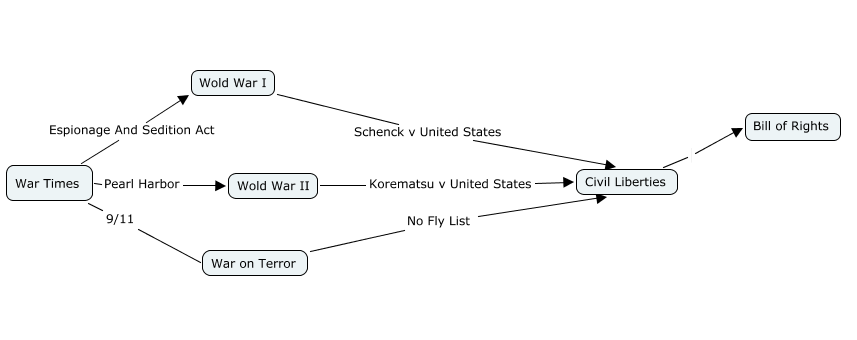
Concept Map of the content taught during the civil liberties during Wartimes Unit
Knowledge of Students to Inform Teaching
Academic Development
Students had a prior knowledge of the Bill of Rights because they learned this at the beginning of the year. Some students understood how a trial is put together because of work they had done in their classes last year, but for the majority of students this was the first time they had been part of a mock trial. Students needed to understand how to ask basic questions first, and then build on those questions to attempted to prove their case. Some of my students have lower reading skills which makes it very difficult to process information in a way that makes this type of questioning possible. Because of this I scaffolded how to ask questions in a court case in order to prove a point. This scaffolding can be found in the power point presentation called “Asking questions with evidence”.
Throughout this unit all students needed to be able to produce oral and written work. In the lessons leading up to the mock trial students were given multiple ‘at bats’ to use the language associated with the unit and articulate that language to the class. These lessons were to build understanding of this language so the students would feel comfortable with using it in the final assessment. It was very important that students were able to not only express what they saw in the text while looking at Civil Liberties in wartime, but also be able to incorporate their own feelings and opinions on liberty and security.
During the trail all students, regardless of their role, needed to be able to articulate their side of the argument orally to the rest of the class. Of coarse this skill is easier for some students then others. Because I knew some students would have trouble with the oral aspect of the trial I made sure to give students a lot of work time so they would have what they wanted to say written down before the trial began. I did not lower my standards for certain students I just made sure they had what they needed in front of them so they could be an asset in the trail. It was very important that students used the Bill of Rights, and other evidence throughout the trial as well as certain buzzwords that would make their case stronger.
Family/Community/Cultural assets
This unit on civil liberties in wartime was very relevant to the lives of my students. Although most were in 1st grade when the twin towers were hit on September 11th, 2001, my students enjoyed being able to share their memories of the event-something they do not often get to do in United States history. Students were able to share their stories about September 11th and they were also asked to have a conversation with their parents about where they were when the Twin Towers where struck and how the event affected them. I believe that social studies is a great way to start up conversations between parents and their children. Whenever there is a chance for families to have these important conversations with each other it is essential as a teacher to jump at these opportunities.
Social and Emotional Development
Throughout this unit students have the ability to express themselves in a multitude of different ways. There are multiple lessons where students worked in groups to answer questions and complete projects. The nature of this unit lends itself to the development of social and emotional skills. Students are being asked to not only examine the historical content, but also analyze their own perceptions of civil liberties and how they play into the their understanding of broader current political issues. Students in their late teens need to be exposed to this type of thinking so they are better equipped to deal with and understand the current issues in the world. Collaborative learning is essential in this unit especially in regards to the mock trial. Students were put in positions were they needed to create professional relationships with their peers in order to put on a successful mock trial. Students needed to come to class prepared to play their respective roles in order to make their claim and participate in the case.
Analysis of pre-assessment.
The pre assessment that was given to the students told me a lot about the type of tools they had in their toolkit. I gave students a multiple choice reading test that about the PATRIOT Act. Although this test was mainly to assess reading skills it also shed light on whether or not the students understood the importance of legislation like the PATRIOT Act. I also gave a survey about the workings of the court system to see how much front loading needed to be one before we being working on our class trial. Students for the most part understood court cases and the how they have been used to shape history as well as the laws that govern our land. However, I was not sure that students understood logistically how court cases can make such an impact; the students knew the what but not the why or the how. It became apparent to me that I needed to model the type of thinking used by lawyers to decide if a law is constitutional according to the bill of rights. I was glade that I came to this realization because this guided my planning of lesson two bout how to make questions based on evidence. The information from the pre assessments also guided me in the scaffolding of the pre trial work sheets that each student needed to complete in order to be prepared for the trial. These worksheets can be found under "Trial Preparation Worksheets".
Description of Text Used
United States of America. (1789). United States Constitution-Bill of Rights Washington: United States of America.
The Bill of Rights is the name for the first ten amendments to the United States Constitution. These ten amendments for the most part limit the power of the federal government. In doing so, the amendments guarantee citizens of the United States certain rights. The Amendments were written in 1789 by James Madison, and was the first time that the idea of personal rights had been instilled into the minds of the American citizenry. The Bill of Rights went into effect in 1791, when 3/4 of the states agreed that they were fair. The Bill of Rights is the center of many important court cases that deal with the age old question of what is more important?- liberty or security. Proponents of liberty usually use the Bill of Rights to prove that Americans are granted rights that protect their independence and l=choice in how they live their lives. Advocates of security usually attempt to prove that in certain times and circumstances these liberties need to be suspended allowing the good of the many to outweigh the good of the few.
Supporting Learning in English-Language Arts
It is very important for a teacher to understand their students and to constantly have their students in mind when planning for instruction. My students were at the forefront of my thoughts when planning the ‘civil liberties during wartime’ unit. Although most of them were in 1st grade on September 11th, 2001, my students still were very familiar with the terrorist attacks and the issues surrounding that day. Because I knew that my students would be familiar with this I decided to start this part of the unit with a share out of the feelings they experienced that day. This was a great way to hook the students because the realized that even though they were very young 9/11 affected them in numerous ways. I then lead this discussion into feeling safe and secure as oppose to having liberty. Because we had been building off of background knowledge, students were more comfortable and had a better grasp on the concept of security and liberty.
In order to build connections between students, I asked lot of questions and had students share their responses to those questions. The questions formed the four-corner activity at the being of lesson one and allowed for a lot of discussion amongst the students. Students were able to take a strong stance on these questions and they brought up a lot of interesting points that had not been talked about in earlier lessons from the this unit. This set the mood for the rest of the learning segment because students were excited about voicing their opinions about this subject. This aided my students in learning new concepts and content knowledge. The students realized that their lives were affected by this debate over security and liberty everyday. It was more interesting for my students to learn the content when they could find connections to their own lives.
When learning about the Supreme Court and the constitution many misconceptions can arise. Students often have trouble with understanding the role of the Supreme Court in interpreting the constitution. It is hard for students to understand that although the constitution is a document of stability it can be interpreted many different ways depending on the person or group of persons. Students may not understand how a document that is hundreds of years old can change its meaning with out changing any of the writing on it. I decided to address these misconception by having the students think about times when their personal beliefs, culture, or background have influenced their opinion on something that they were suppose to stay neutral on. This helped students to understand that although the Supreme Court Justices are suppose to follow terms such as "without respect to persons" and "impartially discharge" people often make unconscious decisions based on their own experiences or beliefs that may alter their understating of the constitution.
Many of my students have very low reading levels, which can lead to a lot of problems in a social studies class. It is imperative that students read and analyze primary sources in a history class, however most of these sources are hard to read and comprehend on many different levels. It is always a struggle, yet a necessity, for me as a teacher to make these difficult primary documents accessible to all of my students. In planning for this specific learning segment I knew that I wanted my students-all of my students- to read the Bill of Rights and to understand it. I decided to create an abridged version of the amendments. This made them shorter and easier to understand with modified vocabulary and sentence structure.
The first time that our class read through the Bill of Rights I made sure to do a lot of modeling. I made sure that all the students were following along and annotating as I did a read allowed and annotated on screen. I modeled for a lot longer than I would for other types of texts because I knew that we would be using this document a lot and students needed to understand how to analyze such an important piece of work. When students were finally allowed to try out the annotating on their own, I pulled the lower readers aside and gave them some further guidance on the document.
Key Academic Language Demands
Throughout this unit the development of certain vocabulary words and concepts was very important. Students needed to be able to not only know the meaning of certain words, but also be able to use those words in their answers to questions and in the mock trial at the end of the unit. Understanding concepts like civil liberties, Bill of Rights, Constitution, Supreme Court, amendments, liberty, security, argument, prosecution, defense, were integral to success in the mock trial because in court cases all of those concepts are so intertwined. Students needed to be able to use certain vocab words in the trial. The Bill of Rights was very important because the court case was questioning the constitutionality of the ‘No Fly List’. Students needed to use those important vocab words in order to get their point across and make their claim. The art of creating an argument was also a very important aspect of this unit. Students needed to be able to articulate their claim and phrase questions in a way that would prove the point they were trying to make. The skill of articulation was essential to a positive outcome in the mock trial and even students who were not attorneys still had to prove that they could build a case from evidence and question using evidence.
Because of the high level of thinking that needs to take place in order to put on a mock trial, there was an immense amount of scaffolding before the trial started to support the students and guide them to a better understanding of the court system and civil liberties. From the very beginning of the unit students were shown how to examine the Bill of Rights and use them to decide the validity of laws. Students were provided with a copy of the bill of rights, which they worked with multiple times throughout the unit. Each time students used the Bill of Rights in class they were provided less and less support until it was time for their ending assessment-the Mock Trial. For students with lower reading levels their was more guided scaffolding in their instruction. These students received a version of the Bill of Rights that had certain words defined in parenthesis as well as modified documents that pertained to the trial preparation. There were also planned instructional supports to help students understand how to create an argument based on evidence. This was the second lesson in this learning segment. Students were given a scenario and then were shown how to come up with basic level questions, connecting questions, and then the evaluation questions. This support was essential to the creation a trial because most students did not understand at first how to make a case base on evidence and then to furthermore present that evidence to a court.
Monitoring Student Learning
Throughout the unit students are being assessed on their knowledge of the content and their ability to use that knowledge to evaluate the validity court cases and federal laws. The development of this type of thinking is an ongoing process and took different types of assessments and lessons to allow students to fully comprehend the task at hand. The fist assessment was a multiple choice test which assessed the students knowledge of content and reading skills. This test also evaluated whether or not students understood the fragile dichotomy between court cases and federal law. The culminating assessment was a mock trial. To participate in the mock trial students needed to understand the content well enough to defend a claim. In order to monitor the progress of my students so they would be able and prepared to participate in the mock trial I set up many smaller informal assessments. In the first lesson of this unit students were told to take a stand on how they viewed their civil liberties. Students were asked to decide what was more important to them- freedom or security. They assessment of the students understanding of freedom or security was their ability to articulate there opinions of these statements: 1) Sometimes personal rights must be given up in order to protect people from those who could be a danger to all of us. 2) It's better to be safe than sorry when it comes to fighting terrorism. 3) The government should have the right to investigate to the fullest extent any suspicious person and their activities. 4) Civil Liberties have been granted in the Constitution's Bill of Rights and should be preserved, no matter what. Students not only had to agree or disagree with these statements, but they also had to explain why. This assessment shed light on whether or not the students understood the idea of civil liberties as a spectrum instead of a concrete yes or no concept. Students also read scenarios that depicted different people at risk of having their civil liberties violated. Students had to use the Bill of Rights to decide who, if any, of the characters in the scenarios were losing some of their rights. These assessments helped to show whether or not a student was able to use the Bill of Rights to make a claim. It was also important that these assessments were full class because it allowed for students to model this type of thinking to each other.
While taking the multiple choice test some students with lower reading abilities were allowed to take extra time. This helped the students demonstrate their learning because they were able to take the time they needed to read through all of the questions and then select the correct answer. In preparation for he trial the students received a graphic organizer to help organized their thoughts and their speaking points. This helped students organize what they where going to say and to see how what they were saying was going to impact the entire trial. This ‘big picture’ aspect of this unit was really important and the only way for students to see this big picture was to understand that their specific part of the trial feed into a much larger idea of civil liberties.
Concept map of skills combined with content of the civil liberties during wartime unit