School and Community
The context where learning takes place is a very important aspect of planning and implementing instruction. Understanding the school and community one teaches in is vital to creating the best instruction for the students. I teach at Chicago Academy High School. In this school I teach four different classes. I teach a Senior Seminar class, Junior Seminar class, A.P. United States History, and -the class for which this planning and assessment is for- United States History. The community surrounding Chicago Academy High School is very much affected by many Polish and Hispanic influences. I neighborhood is very old and hold homes that have been around since the 1920s. Unlike many other communities throughout Chicago, the Portage Park area has not been uprooted or transformed in a drastic way. Throughout my residency I have learned that many of my students do not live in the neighborhood that encompasses Chicago Academy. Many students come from West of the schools coordinates of Austin and Addison. This community is more crime stricken and impoverished then the community where the school sits. The parent involvement varies from family to family. I have noticed the common trend that the families who come to report card pick up are usually not the parents whose children are failing the class.
Parent involvement of students in my A.P. class and Senior Seminar class has been extremely good. However these students tend to be the higher achieving students and are often not having huge issues when it comes to grades and attendance. The classes were parent involvement is uncomfortably low is in my regular United States History class. Around 15% of these parents come to report card pick up, and usually do not follow through with what they say they are going to do to help raise positively influence their children.
The resident team at Chicago Academy on our community walk around the Chicago Academy HIgh School neighborhood. |
Chicago Academy High School is part of the A.U.S.L. network. The Academy for Urban School Leadership has a set of signature strategies that help to manage classroom behavior, increase instructional rigor, and hold students accountable. These signature strategies are also used and promoted by my mentor and mentor- resident coach. I am expected to plan my lessons according to these signature strategies and then implement them by using the strategies. Because these expectations are network wide they are well known and well manage throughout a host of different schools. Chicago Academy High School is a considered a college prep academy. This school takes the college readiness standards very seriously and all units and assessments are geared around these standards. Standards based grading is how Chicago Academy High School keeps these college readiness standards in the grading system. Students must be passing all of the set skill and standards for a given class in order to pass the class. This makes it very difficult to pass a class if the student has not shown understanding of all of the set skills for that class.
The use of certain signature strategies has proven to be extremely beneficial throughout the school year. I have found that narration, when done correctly, can be the only strategy needed for managing the classroom. My students at Chicago Academy High School are pretty observant. When other students are doing something different than what they are doing, the students notice it. Narration is a great way to not only manage behavior, but also express the directions of what to do again, in an unthreatening positive way. It is a great way to decipher between the students who are being defiant and students who simply did not understand the directions. Because CAHS is in the AUSL network students are very familiar with the strategy of narration and the other strategies from Doug Lemov’s Teach Like A Champion. These signature strategies have allowed me as a teacher focus on the instruction of the content and not as much on the behavior management aspect of teaching.
As a social studies team, we focus on the technique Ratio- the proportion of the cognitive work students do in the classroom. It is very important to the social studies department that students learn how to answer higher order thinking questions. Teachers lecturing to students taking notes do not master important skills like these. The only way that we can promote this type of thinking is if students are extremely active in the problem solving and deep thinking in the class. As a department we make sure to constantly up the rigor and promote positive learning experience so students leave high school with those problem solving skills needed to be successful in todays society.
Data Use and Assessment
In the AUSL network of schools students are constantly assessed throughout the school year. There is formative data in the form of exit tickets and checks for understanding. These help the teacher plan for re-teaching opportunities and pinpoint misconceptions that students might have had. On a bigger scale students are assessed with interims every quarter. In my United States history class students are assessed on three different skills every quarter with the interims. The skills that are measured are reading, writing, and content knowledge. This data is used for teacher reflection and to show growth in these skills throughout the year. These interims help to guide planning and instruction because the teacher is able to see what skills students are struggling with and what skills they need are improving on.
The Class
I administered this learning segment on an 11th grade United States history class. This class is year a long class and meets three times a week for 45 minutes on Monday and 90 minutes on Tuesday and Thursday. Students that take this class are average to below average in their skill levels. This class is not tracked, but their is an advanced placement United States history class that students can choose to take it they want. The A.P. class is substantially more challenging compared to the regular U.S. history class and there is usually a lot of downward movement form A.P. to regular in the beginning of the year. This class does not study history chronologically like most history class. At Chicago Academy High School this U.S. history is taught thematically. The major themes are broken up by quarters which include an over arching question. This learning segment was taught in the third quarter with the over arching question being “Does the good of the many outweigh the good of the few?”
The text books that are used in this class are differentiated according to reading level. A Short History of The United States by Robert V. Remini is used for students with a higher reading level (17 or higher on their practice ACT test) and A Young People's History of the United States: Columbus to the War on Terror by Howard Zinn is used for students with a lower reading level (16 or lower on the ACT practice test). The classroom is equipped with a projector, white board, elmo, a laptop cart with 30 computers, and a larger historical library. The classroom is decorated with lots of historical posters and signs. The desks are arranged in a horseshoe model that helps for class discussions.
The Students
The students that participated in this leaning segment are juniors in high school with the exception of three seniors who are taking the class for a second time. All of my students are 16, 17, or 18. There are 23 students in my 2nd period class. There are 13 girls and 10 boys. I have three English language learners in the class as well. All of the students that have IEPs were placed in my first hour History class so I have no students with IEPs in the 2nd period class I performed my learning segment in. I do have two students who get extended time on tests and reading assignments.
Throughout this learning segment I found that my students became extremely engaged in the mock trial activity. By examining student work from the pre trail worksheet it was evident that most students had completed the needed work for the trial. Completing these worksheets was important to success. The pretrial work allowed for students to become very familiar with the witness testimony and confident in their abilities to articulate their evidence. While students were preparing for the trial there was little off task behavior because students were very engaged in the work. My students also work very well in the groups they were assigned. I was especially proud of the way the attorneys worked together to come to present their case. There were many students who I put in the role of the attorney to push their thinking and ability to work with others. I anticipated more push back and more issues with these particular students during the pretrial workshop, but this was not the case.
I was very strategic in assigning the roles for the trial. Along with the assignment of the attorneys, I also put students who often get distracted in class as the witnesses. The role of a witness entailed a lot of reading of testimony and evidence. These students had a lot of work that they needed to do before the trail began and they needed to stay on task in order to be ready when they got on the witness stand. Because I was trying to push the limits of some of my lower performing students, a lot of my higher performing students ended up on the jury. This ended up =making the end trial deliberation very interesting because these students had not been able to talk a lot during the actual trial- and they had a lot to say.
|
Category |
Number of Students |
Accommodations, Modifications, and/or Pertinent IEP Goals |
|
Learning Disability |
2 |
Extended time in reading, close monitoring, extra guided practice in reading witness testimony |
|
English Language Learners |
3 |
Extended time in reading, extra guided practice in reading witness testimony, extra guidance on vocabulary and concepts |
contributing to the world through the power of education. We have a dual mission: to provide a supportive college preparatory environment for students and a collaborative mentoring experience for aspiring teachers. We share the core values of compassion, integrity,and reflection, which we call the Learner’s Life. By infusing school culture with these qualities, we seek to inspire excellence in ourselves and our community
| 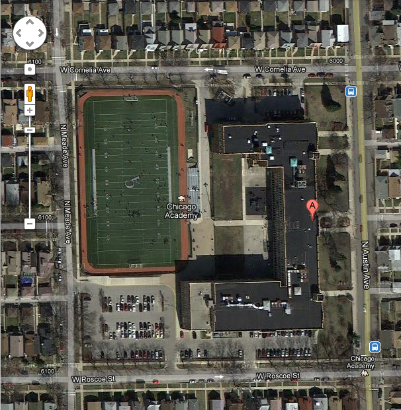 Birds eye view of Chicago Academy HIgh School |
